

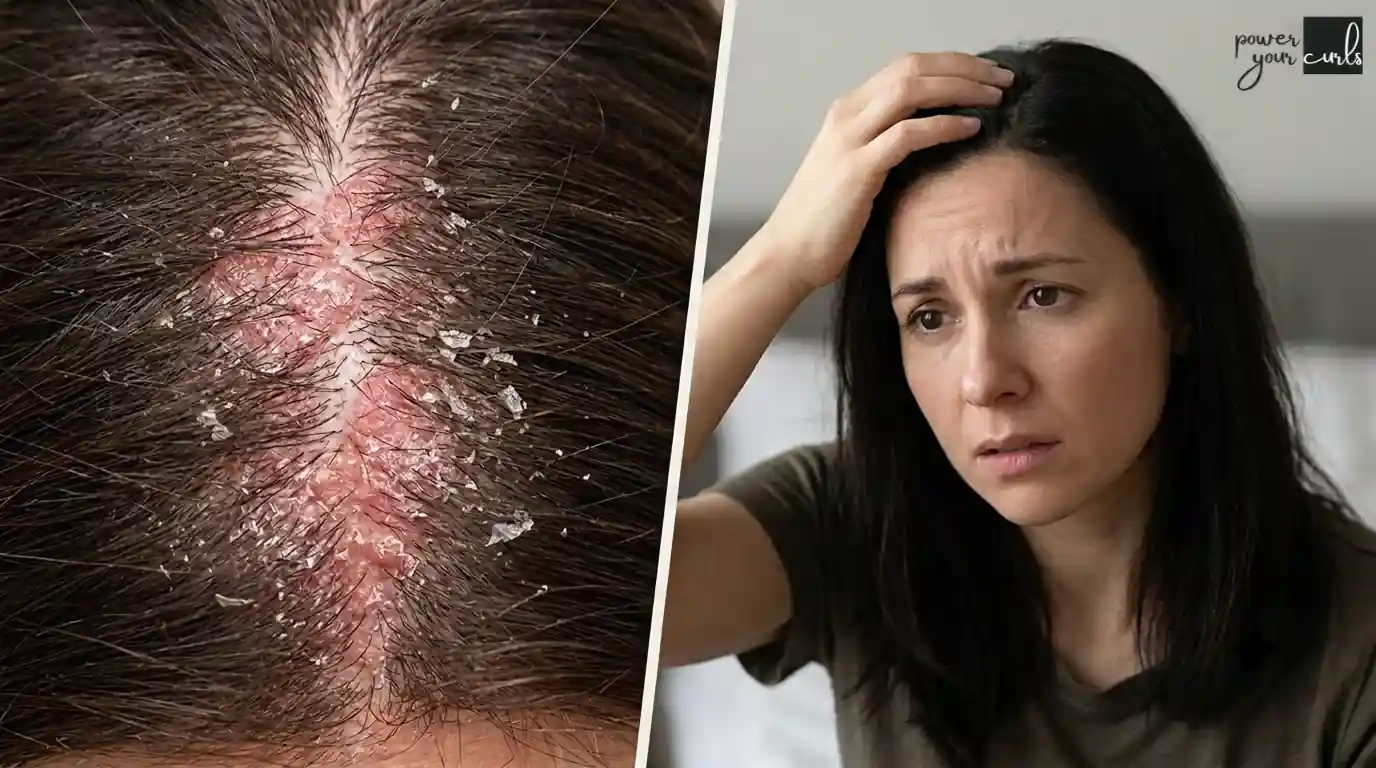
Scalp involvement is estimated at 45% to 56% of people with psoriasis, and for most of them, the hair appointment is where the condition is hardest to hide. In a 2020 online survey of people with scalp psoriasis, two-thirds said they had deliberately postponed or avoided a barber or hairdresser appointment, and 40% felt uncomfortable discussing the condition with their stylist. A separate US study found that 27% of surveyed laypeople believed psoriasis was contagious. The evidence below shows how those numbers play out in the salon, and how they narrow the hairstyles people feel able to wear.
The 2026 World Psoriasis Day theme is “Look Beyond My Skin”. The campaign focuses on young people, since nearly one third of people with psoriasis develop the disease before age 18, and it asks for the person behind the condition to be seen. For many people with scalp psoriasis, the hair appointment is where being seen is hardest. Sources: IFPA World Psoriasis Day 2026, ILDS
Scalp involvement is the norm, not the exception
How common it is
The prevalence of scalp psoriasis among people with psoriasis is estimated at 45% to 56%, and other studies put involvement at 80% to 90% at some point in the disease. Source: MDedge review
In a global web survey run between March and December 2025, the scalp was the most commonly affected area in both the US (66.5%) and Germany (50.8%). This is a congress poster with industry co-authors, so treat it as supporting context. Source: Augustin et al. poster
In the UK, more than half of the estimated 1.8 million people with psoriasis have it on the scalp, and it can also show around the hairline, forehead, neck, and behind the ears. That makes it visible beyond the hair itself. Source: Modern Barber
How it looks on skin of colour
- On skin of colour, lesions can look purple, grey, or dark brown instead of red, and flaking is easily mistaken for dandruff. Sources: WebMD, MDedge
- Among Asian, Hispanic, and African-American/Black patients with psoriasis, scalp involvement is estimated at 80%, and Asian and Black patients are more likely to present with scalp psoriasis. This figure comes from the background section of a clinical trial protocol, citing Kaufman and Alexis (2018) and Alexis and Blackcloud (2014). Source: NCT05272150 trial protocol
- A US clinical review of patients of colour also reports that Asian and Black patients are more likely to present with scalp psoriasis, and that hairstyling and hair care practices differ considerably between racial groups. Source: MDedge / Cutis
A small patch on the scalp can outweigh the rest of the body
Clinical research suggests the scalp affects quality of life far more than its share of body surface would predict.
What the clinical studies show
In a 2025 American Academy of Dermatology poster on 154 adults with moderate to severe scalp psoriasis (average body surface involvement 10.3%), quality of life was greatly affected across several patient-reported measures, including in patients with less extensive psoriasis elsewhere. The researchers concluded that scalp disease may affect quality of life out of proportion to total body involvement. The data come from PSORIATYK SCALP, an industry-sponsored deucravacitinib trial. Source: Physician’s Weekly
An earlier University of Padua study of 55 patients, using the Scalpdex and SF-36 questionnaires, found that the severity of scalp lesions was linked to lower quality of life regardless of how severe the disease was overall, and attributed this to the highly visible site. Source: University of Padua
Self-esteem, body image and treatment
In a study of 92 patients with psoriasis and 98 controls, the psoriasis group had significantly worse quality of life, lower self-esteem, and lower body-image scores (all P < 0.001). Source: PMC5621194
A latent-profile study found that patients with the most negative body image had the lowest life satisfaction, and notes that negative body image affects treatment adherence and outcomes, not only well-being. This is the link between how people feel about their scalp and whether they keep treating it. Source: PMC7847870
Two in three people with scalp psoriasis have avoided a hair appointment
The strongest salon-specific figures come from the Heads Up to Psoriasis campaign, run by the Lions Barber Collective, the Psoriasis Association and LEO Pharma.
- Two thirds of people with scalp psoriasis had deliberately postponed or avoided an appointment with their barber or hairdresser. The findings predate COVID-19 restrictions. Source: Modern Barber
- 40% felt uncomfortable discussing their scalp psoriasis with their hairdresser, and more than half agreed that practical training for hair professionals would help. Source: Cosmetics Business
- Method: an online survey of people living with scalp psoriasis, run 6 to 13 August 2020. The coverage found does not give the sample size, and the campaign was partly industry-funded.
Clinical research treats the salon as a measurable part of life with scalp psoriasis. Scalpdex, the scalp-specific quality-of-life questionnaire, includes items on whether the condition makes it hard to go to the hairdresser, affects how the person wears their hair (hairstyle, hats), and bothers them through other people’s questions. Source: Scalpdex item list
Salon avoidance
The hair appointment, by the numbers
Have postponed or avoided a barber or hairdresser appointment
Felt uncomfortable discussing it with their hairdresser
The beliefs a stylist brings to the chair are measurable
The 2018 Penn study in the Journal of the American Academy of Dermatology surveyed 198 laypeople online and 187 medical students, all shown images of psoriasis.
- 57% of laypeople said people with psoriasis are insecure, 53% said sick, 45% said unattractive, and 27% said contagious. Source: Penn Medicine
- On social avoidance, 54% would not date someone with psoriasis, 39.4% would not shake hands, and 32.3% would not want them in their home. Source: Consultant360
- People who knew someone with psoriasis held fewer of these beliefs, and the medical students were less stigmatizing than the general respondents. Sources: Medical News Today, UPI
The study did not survey hairdressers. The handshake figure is the closest proxy for a job that involves hands-on contact with the scalp, but applying it to stylists is an inference, not a measured result. Senior author Dr Joel Gelfand also told Reuters Health that his patients describe feeling embarrassed at the hair salon. That is a clinician’s observation, not survey data. Source: Reuters Health via Physician’s Weekly
Stylists report limited training, and clients report rejection in body-care settings.
- In Malaysia, the Psoriasis Association ran a workshop programme for hairdressers and barbers. Its report says 77% were aware of scalp psoriasis, but only 19% felt confident identifying its symptoms while working. Source: PAM report
- A later account of the same programme says fewer than 22% of surveyed hairdressers claimed knowledge of scalp psoriasis and only 15% had formal training. The two accounts give different headline figures, so check the original report before quoting either. Source: IFPA member article
- A German research group found in a survey that body-care providers, including hairdressers, cosmeticians, podiatrists and physiotherapists, are a setting where patients often report stigma and rejection. It has designed an anti-stigma programme for these professions, but results are not yet published. Source: DKVF 2022 study protocol
- Patients on the Psoriasis Association forum describe being refused a pedicure, a facial and a massage. One member suggested phoning a salon ahead of time, and reported that a senior stylist agreed to colour and cut after a patch test. These are anecdotes, not data. Source: Psoriasis Association forum
Stylist readiness
Malaysian hairdressers: aware, but not confident Sources disagree
Programme report
Later account of the same programme
Nine points in a salon visit where stigma can surface
No study has mapped the salon visit step by step. The interactive graphic below places the evidence above on that timeline. The last column says whether each point is measured, reported anecdotally, or inferred from related data. PYC’s community stories could fill the inferred rows.
Hairstyle choice narrows from three directions.
Three pressures act on the same head: the wish to conceal, the need for treatment access, and the need to avoid triggering a flare. The data on each:
- A 2025 research letter on 350 patients with scalp psoriasis found that nearly half felt ashamed or embarrassed, and over half worried about incurability and recurrence. Functional limits included difficulty with hairstyling, choosing clothing, and social interaction. 76.3% had sensitive scalp syndrome (33.4% slightly sensitive, 24.6% sensitive, 18.3% very sensitive). Source: Sensitive scalp syndrome study
- A clinical review reports that many patients grow their hair long or wear hats to hide lesions, and that flaking affects clothing colour choice some, most, or all of the time for a share of patients. In one study cited there, more than 70% reported difficulty with daily life. Source: MDedge review
- In an Italian Scalpdex study of 194 patients (78% with psoriasis), the most frequent items were shame, embarrassment, self-consciousness, and clothing colour being affected. Scores were higher in women and in younger people. The cohort included psoriasis and other scalp conditions. Source: Acta Dermato-Venereologica
The advice that protects the scalp and the styles that hide it pull in opposite directions. That is this article’s synthesis, not a measured finding. A client who wants coverage is steered toward styles that can block treatment, while the services most associated with feeling good about hair (colour, relaxing, blow-drying) are the ones to avoid during a flare. The result is a short list of acceptable options, and the choice is often made by fear of being seen rather than by preference.
For curly and textured hair, wash day becomes a fourth pressure
Most scalp psoriasis guidance assumes hair that is washed often and is easy to part. For curly, coily and Afro-textured hair, the research points to a further conflict between the treatment routine and the hair care routine.
Treatment built for straight hair
Hair texture, hairstyles and hair care practices in skin-of-colour patients may make topical treatments impossible to use or tolerate. A trial protocol warns that this can lead to undertreatment and increasingly severe scalp psoriasis, and describes the gap as a significant unmet need. Source: NCT05272150 trial protocol
Medicated shampoos are usually meant to be used twice a week or more, which conflicts with many Black patients’ normal wash routine. One patient quoted: “I am a Black woman and washing my hair every day was not an option.” Source: CreakyJoints
What dermatologists advise
Dermatologist Dr Andrew Alexis notes that a daily medicated shampoo could be resisted and could cause breakage, given the greater fragility and dryness of Afro-textured hair. He advises asking patients whether a water-based solution, lotion, foam or oil-based product suits their hairstyle before prescribing. Source: Dermatology Times
Canadian dermatologists report that patients with Afro-textured hair often wash less frequently, that some scrape their scalp to remove plaques, and that follicular psoriasis, a rare variant, is more common in patients with Black or Brown skin. They note that misdiagnosis can delay treatment. Source: Skin Substack: Afro-textured hair
A Canadian consensus report on psoriasis in skin of colour recommends that hair texture, care patterns, washing frequency, head coverings and patient preference all be considered when planning scalp treatment. Source: Skin Substack: Canadian consensus
Recognition and representation
Recognition is a barrier before treatment even starts. One dermatologist reports being told repeatedly that “black people do not get psoriasis”, and plaques on darker scalps can read as purple, grey-brown, or simply darker than the surrounding skin rather than red. Sources: MDedge / Cutis, Black Health
The evidence base is thin. Black patients were 2.2% of participants in the psoriasis clinical trials reviewed, against an estimated 5.7% of the patient population. A dedicated skin-of-colour scalp psoriasis cohort (VISIBLE, Cohort B, 108 adults) is one of the few exceptions. Sources: Skin Substack: scalp psoriasis in skin of colour, Black Health
Where this leaves curly and textured hair
Put together, someone with curly or textured hair is choosing between a treatment schedule built for straight hair, the styles that protect fragile hair, and the styles that hide plaques. That is this article’s synthesis of the sources above, not a measured finding.
Wash-day conflict
Two routines, one scalp
Typical medicated-shampoo guidance
- Use twice a week or more (CreakyJoints)
- Some regimens are prescribed daily (Dermatology Times)
- Needs direct access to the scalp, which tight and covering styles block (WebMD)
Curly and textured hair practices reported by dermatologists
- Washing less frequently (Canadian dermatologists)
- Afro-textured hair is more fragile and dry, so frequent shampooing risks breakage (Dr Andrew Alexis)
- Protective styles, preferred product textures and head coverings shape what treatment is usable (Canadian consensus)
Hair thinning and density add a second worry.
The Psoriasis Association notes that some people with severe scalp psoriasis may experience thinning. Source: Psoriasis Association scalp psoriasis information sheet
Hair loss is usually reversible once psoriasis is effectively treated, but permanent (cicatricial) hair loss and generalized telogen effluvium have been reported. Some patients instead have increased hair density, which can make topical medication harder to apply and affect adherence. Source: MDedge review
Women and visible lesions
Scalpdex scores were higher in women and in younger people in the Italian study above.
A Journal of Clinical Medicine study of 122 patients found that visible lesions on areas such as the face and scalp were linked to greater stigmatization, particularly among women. Source: PMC10573936
A study of 115 patients also found women more stigmatized, but linked higher stigma to lesions on the back of the hands rather than the face. Which visible site matters most is mixed, so the safer wording is visible lesions, not scalp alone. Source: PubMed 28069297
Young adults
World Psoriasis Day 2026 centres on 18- to 35-year-olds. IFPA notes that nearly one third of people with psoriasis develop it before 18, and that its impact often extends into adulthood, at the age when identity and appearance carry the most social weight. Source: IFPA World Psoriasis Day 2026
Burden by group
Where the burden is reported to be higher
- Women vs men Women More stigmatization with visible lesions such as face and scalp (122 patients); also higher in a 115-patient study.
- Younger vs older Younger Higher Scalpdex scores in an Italian study of 194 patients (cohort mixed psoriasis with other scalp conditions).
- Visible vs non-visible lesions Visible Linked to more stigmatization (122 patients), though which visible site matters most is mixed (hands in one study).
- Scalp severity vs overall severity Scalp Scalp lesion severity linked to lower quality of life regardless of overall severity (Padua, 55 patients; AAD 2025 poster).
Guides for stylists exist, but their effect is unmeasured
What exists
Heads Up produced two guides, one for conversations with healthcare professionals and one for conversations with hairdressers and barbers. Source: Psoriasis Association
The Psoriasis Association of Malaysia published guidelines for hairdressers, endorsed by four national hairdressing and barbering associations. Source: IFPA member article
What is missing
No source found reports whether any of these reduced appointment avoidance or client-reported stigma.
What the evidence cannot yet say
Gaps in the salon evidence
The headline salon figures come from one 2020 industry-partnered online survey with no published sample size in the coverage found. No study has measured stylists’ own attitudes, or how often clients with scalp psoriasis are refused service. The Malaysian hairdresser figures differ between two accounts and need checking against the original report.
Limits of the study designs
Most scalp-specific findings are cross-sectional, so they show association, not cause. The Penn survey was conducted online, and student samples in the US, and the hairstyle restrictions come from clinical guidance, not counts of what people actually wear. The 2025 AAD poster data come from an industry-sponsored drug trial population with moderate to severe disease, so they may not reflect milder scalp psoriasis.
Representation and the curly-hair evidence
People with skin of colour are underrepresented in psoriasis trials, so most quality-of-life figures above come from predominantly white cohorts. The curly and textured hair evidence is mostly clinical commentary, consensus guidance, and trial-protocol background, not measured outcomes in people with curly hair.
