
Hair loss concern, expected or otherwise, is more common than you think. Nobody is immune to such a human condition. However, it’s not always the same in countries, even states. If you have hair loss, chances are the state you live in might also have a hand in it.
Looking into the facts, we’ve compiled a list of US states that should or shouldn’t be concerned with hair loss. There are also factors that contribute to hair loss concerns per US state. Before we can delve into more, we should define what hair loss is first, along with its causes and types.
- Hair Loss: Definition, Causes, and Types
- Which US States do people have the most concern for hair loss?
- Factors that might contribute to the rising hair loss concern
- Which US States do people have the least concern for hair loss?
- Factors that might contribute to the falling hair loss concern
- The Overall Hair Loss Concern Stats Per State
Hair Loss: Definition, Causes, and Types
The Definition of Hair Loss
Hair loss, as you can expect, means what you think it means. It’s the shedding or falling of your hair. Hair loss affects not your head but also your body. This condition also affects a wide range of ages and sexes, depending on the type of hair loss.
However, it’s not always that simple a concept. Factors may vary, as well as its causes.
The Causes of Hair Loss
There isn’t just any one cause for hair loss. In fact, there could be multiple reasons why someone loses their hair. Here are the most common ones below for your perusal:
- Genetics and heredity
- High Stress Levels
- Tight hairstyles
- Hair Treatments
- Poor blood circulation
- Hormonal changes
- Nutritional factors
- Medical conditions
- Supplements and medications
- Clinical treatments
- Fungal infections
- Thyroid issues
The Types of Hair Loss
There’s not just one type of hair loss in the world, let alone the continent. These types of hair loss differ based on location and severity of the condition, including considerations of permanence.
Alopecia areata
The clinical term for hair loss is alopecia. Adding the term “areata”, which means patchy, Alopecia areata translates to patchy hair loss or spot baldness. It’s an autoimmune disorder that targets the hair follicles in your body, causing patches of hair to fall out.
Anagen effluvium
While alopecia areata came about because of an autoimmune disease, an outside factor causes anagen effluvium. It’s the complete and abrupt side effect of certain radiation treatments like chemotherapy. You can also have this from exposure to heavy metal poisoning and other toxins.
Androgenetic alopecia
Next up is androgenetic alopecia. Contrary to popular belief, it’s the most common type of hair loss on this list regardless of gender. The term for men is male pattern baldness, while its called female pattern baldness for women. This type of hair loss elicits different symptoms per gender as well.
Androgenetic alopecia happens to men earlier in their lives than it does to women. It also specifically affects the crown and front part of the head in men. As for women, androgenetic alopecia starts out as thinning around the top of the scalp.
Cicatricial alopecia
Another form of hair loss from an autoimmune disorder is cicatricial alopecia. As a consequence of other conditions like burns, infections, and exposure to harsh chemicals, this is also known as scarring alopecia. Appearing as bald patches, most cases are considered permanent since it does kill off hair follicles.
Telogen effluvium
Telogen effluvium, on the other hand, is another common type of hair loss but it’s generally temporary. As it is usually caused by stressors like changes in the body, hair does grow back after resolving said stressors. Treatments like vitamin supplements are also available to nip things in the bud faster.
Tinea Capitis
The first hair loss condition on this list that came about from a fungal infection is tinea capitis or scalp ringworm. Impacting children aged three to ten (3-10), it manifests as a circular patch of red fungus in the hair follicles.
Traction alopecia
Lastly, there’s traction alopecia. As the name suggests, excessive hair pulling from stiff hairstyles causes this to happen. This hair loss condition is not necessarily permanent, but it can lead to lasting symptoms if there’s no early intervention.
Which US States do people have the most concern for hair loss?
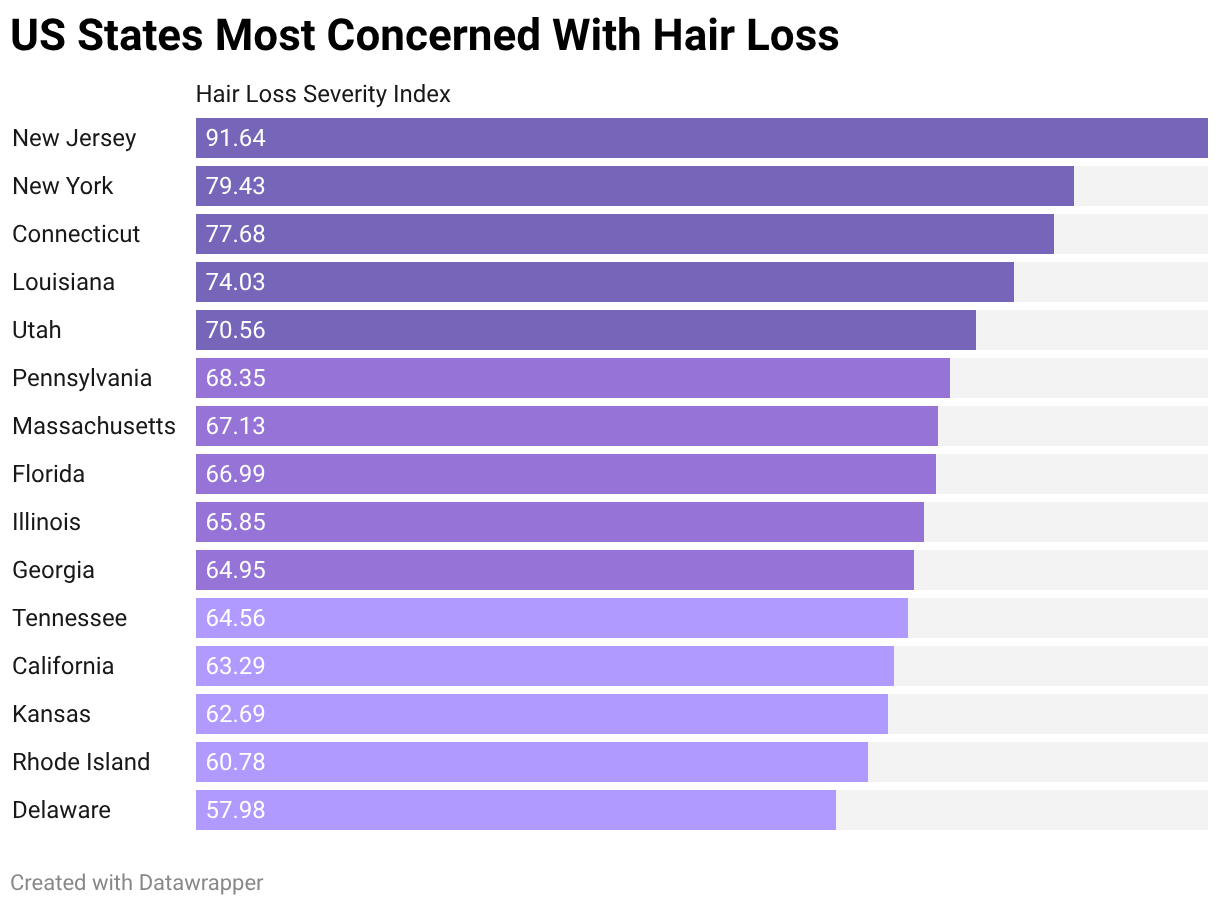
Using the graphic above, it shows that there is real variability among the US states. Concern for hair loss doesn’t just focus on one particular part of the country.
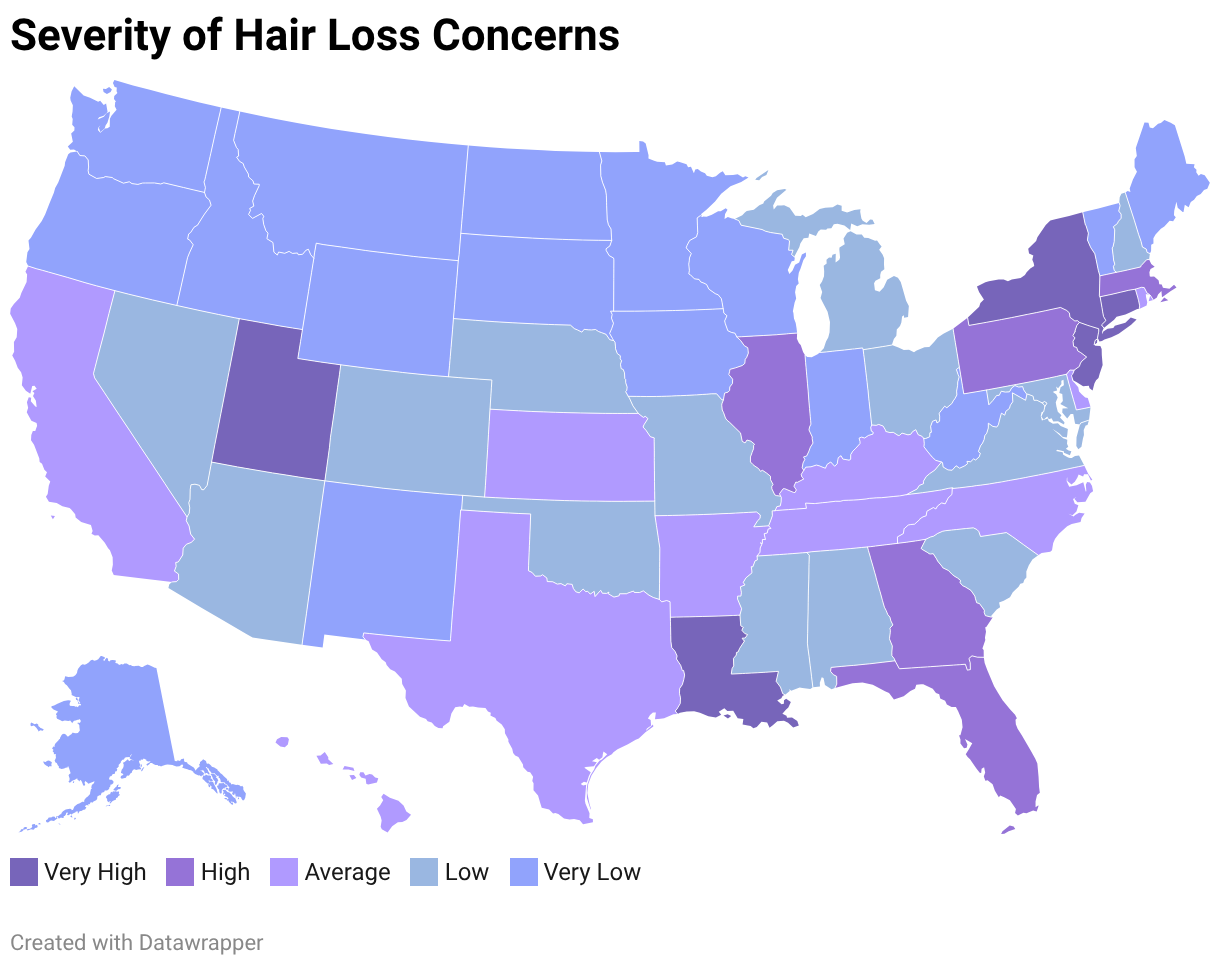
As shown, the middle and lower sections of the country house the states with the most hair loss concern. These states include Illinois, Georgia, and Florida. The center of the more severe cases is Connecticut, New York, and most especially New Jersey.
Factors that might contribute to the rising hair loss concern
Location is not just the main reason certain US states have rising concern for hair loss. Other factors that might contribute to that effect are below:
Environmental Pollutants
The state with the most severe case of hair loss concern, New Jersey, also ranks high on another list: PFAS. In fact, this state is second based on the levels of these contaminants in its rivers. It shows that there’s a link between the presence of environmental irregularities such as these and hair loss.
Income
Various states on this list (California, Connecticut, Massachusetts, and New Jersey) are high-income regions. Having a larger disposable income could lead to higher chances of hair loss treatment options.
Vanity
Another aspect of hair loss concern is vanity. States like California, New Jersey, New York, and Pennsylvania also list high on a study on vanity in 2025.
Air Pollution
Air quality could also be a factor in the rising concern for hair loss in the US. Since air pollution can diminish proper hair growth, research has shown some overlap between the two. Delaware, California, Georgia, Kansas, Pennsylvania, Tennessee, and Utah are only some of these states.
Iron Deficiency
Iron deficiency is a key factor since it can lead to hair loss, particularly in the African American community. Iron-deficiency anemia is prevalent the most in Black non-Hispanic people, according to the CDC.
Tobacco Use
Tobacco use is a leading factor in developing hair loss, particularly androgenetic alopecia. Two of the top states for hair loss concern, Louisiana and Tennessee, are avid tobacco users. So much so that they fall under the banner of a section of the US deemed “Tobacco Nation”.
Which US States do people have the least concern for hair loss?
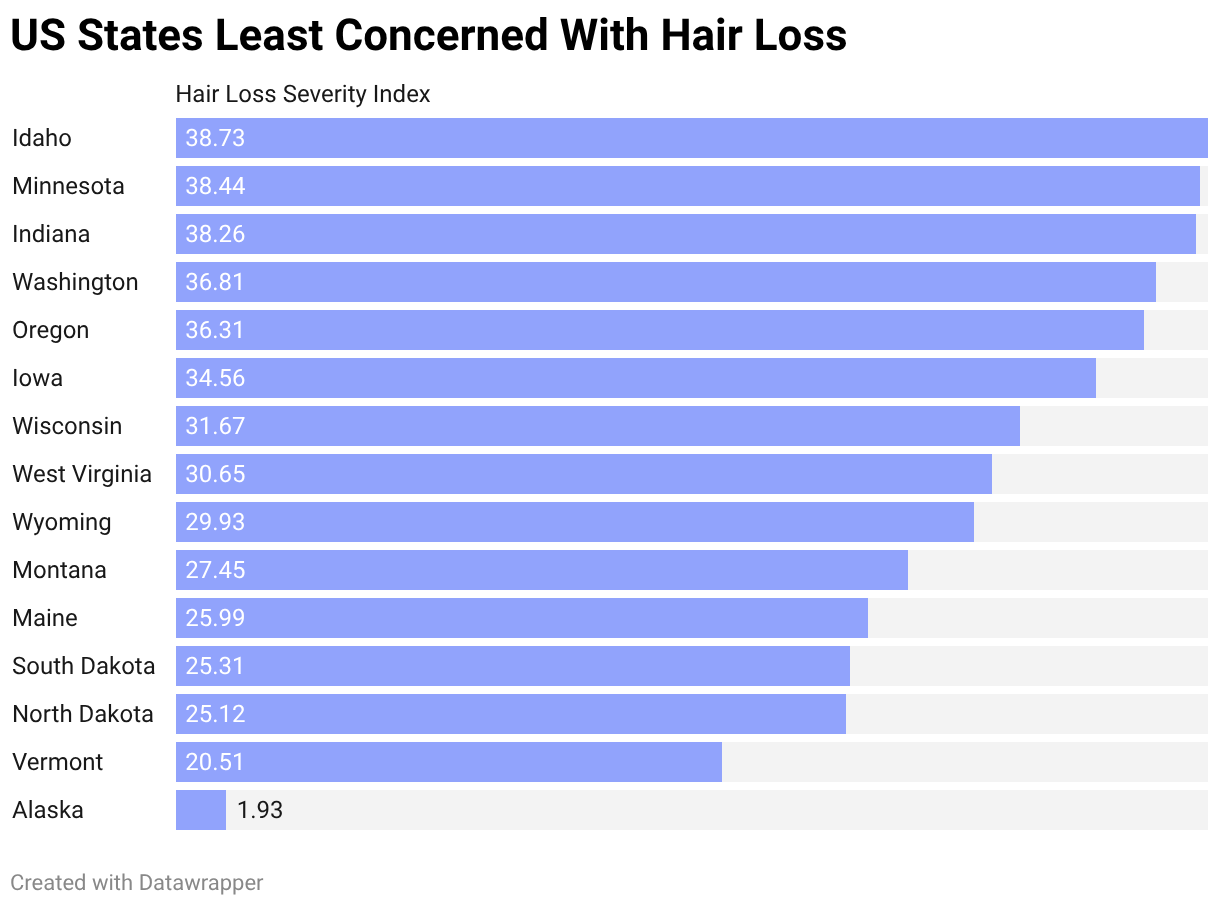
There are more US states that have little to no hair loss concern. The variability lessens on this end. As you can see, these states outnumber the ones with higher levels of concern about hair loss by a wide margin. Some of these states include Washington, Oregon, and Vermont.
The states with the lowest level of hair concern are South and North Dakota, Vermont, and Alaska. The great state of Alaska is at the very top of the list.
Factors that might contribute to the falling hair loss concern
The prevalence of healthy hair growth in these parts can be from a myriad of elements. These factors below cover naturally occurring to man-made conditions.
Health Insurance Coverage
Hair loss treatments aren’t one’s priority when health insurance isn’t widely available. Hence, states with little to no better health care coverage would have resources to pursue hair loss treatments at all. These states include Alaska, Idaho, and Wyoming.
Stress Levels
There’s also a surprising correlation between hair loss concern and the stress levels per state in the US. A sizable number of states (Maine, Montana, Minnesota, Oregon, South Dakota, Vermont, Washington, and Wyoming) feature in both studies.
Sun Exposure
On estimate, there are some states in the US that don’t get that much sunlight throughout the calendar year. The states that also rank low on hair loss concern are Alaska, Maine, Oregon, and Washington, to name a few. They hardly had any regular sun exposure compared to the other states, which meant less sun damage to their hair.
Water Quality
The water quality of a state can affect the level of hair loss concern in a state. The presence of hard water minerals like heavy metals and chlorine can do a number on your hair. Minnesota and North Dakota are only some states on the no-hair loss concern scale with amazing water quality.
Obesity Rates
Hair experts have linked obesity with hair loss. Residents from Idaho, Maine, Minnesota, Montana, Oregon, and Wyoming exhibit the lowest obesity rates among the states.
Climate
Some previous studies propose that hair loss is more prominent in warmer climates. As a result, most of the states on this list are in the colder parts of the country. However, there is a need for further study to verify these claims.
The Overall Hair Loss Concern Stats Per State
Putting all the information together, the final graph of US states is as follows. The map groups the states with the most concern for hair loss in the darkest colour. The lighter the shade gets, the less concern these states have about hair loss.