
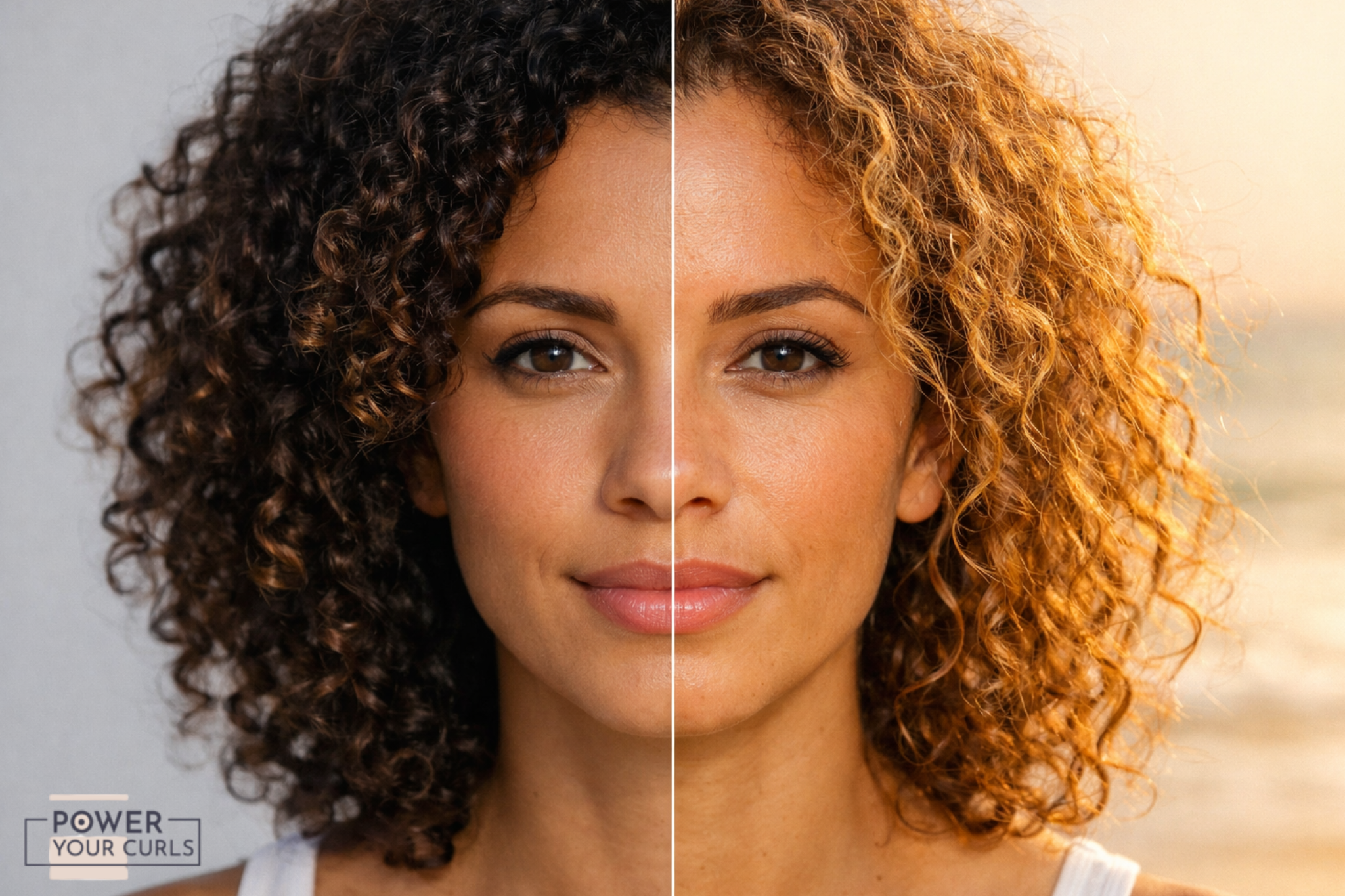
Your curls have a structural secret that makes them beautifully unique. Simultaneously, they’re one of the most sun-vulnerable hair types on the planet. Here’s everything the science says about why, and what you can actually do about it.
Every summer, millions of people reach for sunscreen to protect their skin. They then walk out into brutal UV rays with completely unprotected hair. For straight or wavy hair, that’s risky enough. For curly hair, the consequences can be significantly worse. The reasons behind them go right down to the molecular structure of each strand.

- The Anatomy of a Curl and Why It's Vulnerable
- What UVA and UVB Rays Actually Do to Your Curls
- Why Curly Hair Suffers More Than Straight Hair
- Understanding the UV Index for Curl Safety
- Why Curly Hair Is More Vulnerable: Factor Comparison
- Myths About Sun & Curly Hair Busted
- A Practical Sun Protection Routine for Curly Hair
- Your Complete Sun-Defence Product Arsenal
- What To Do After Sun Damage Has Already Occurred
- 💡 Key Takeaways About Curly Hair and Sun Exposure
The Anatomy of a Curl and Why It’s Vulnerable
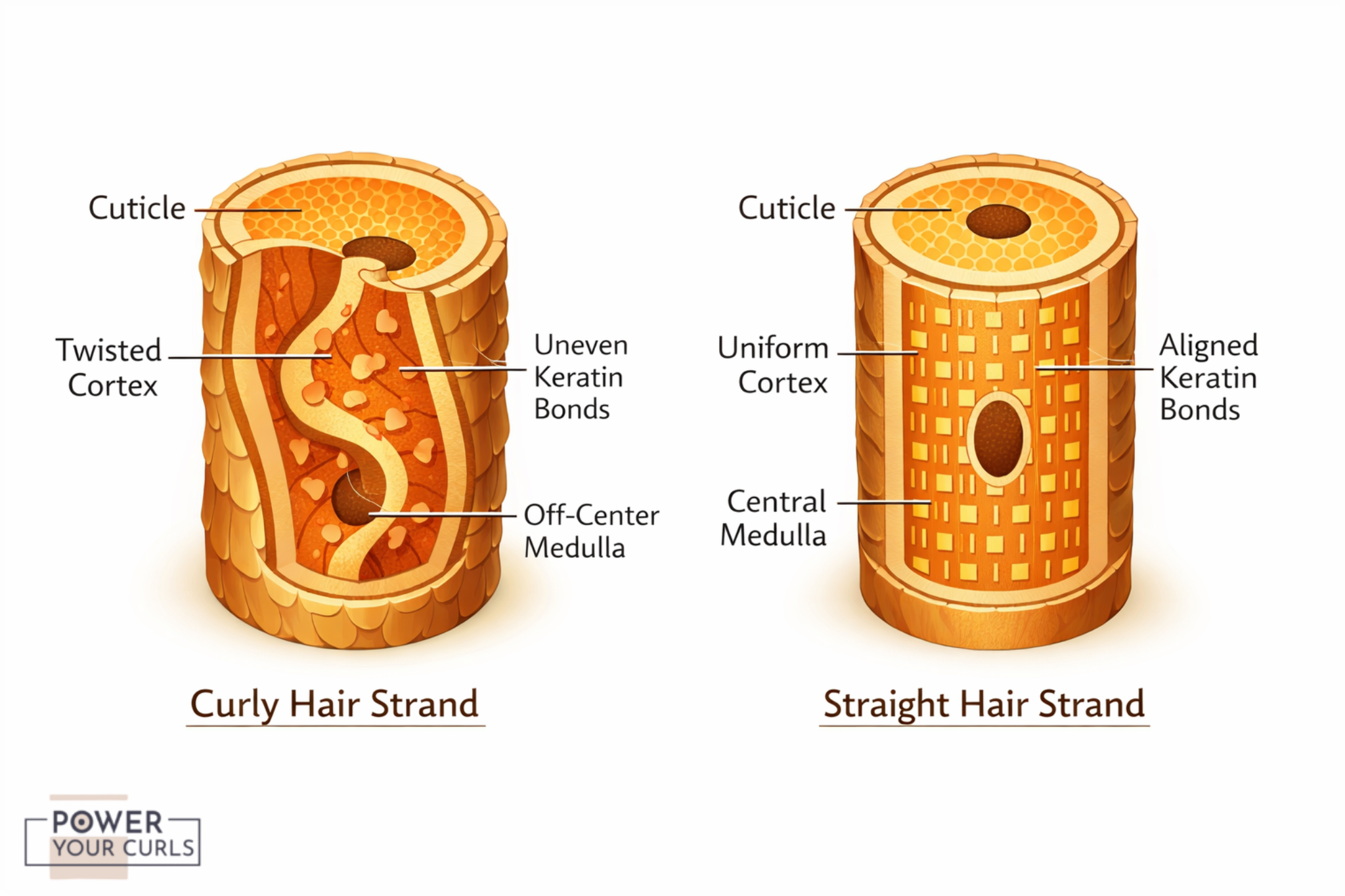
Curly hair differs from straight hair not just in shape, but in its entire protein architecture. The characteristic spiral is caused by asymmetrical keratin bonds along the cortex of each strand. But this same curvature creates a critical problem. The natural oils from the scalp cannot travel efficiently down the twists and turns of the curl shaft. This is why curly hair is inherently drier than other types.
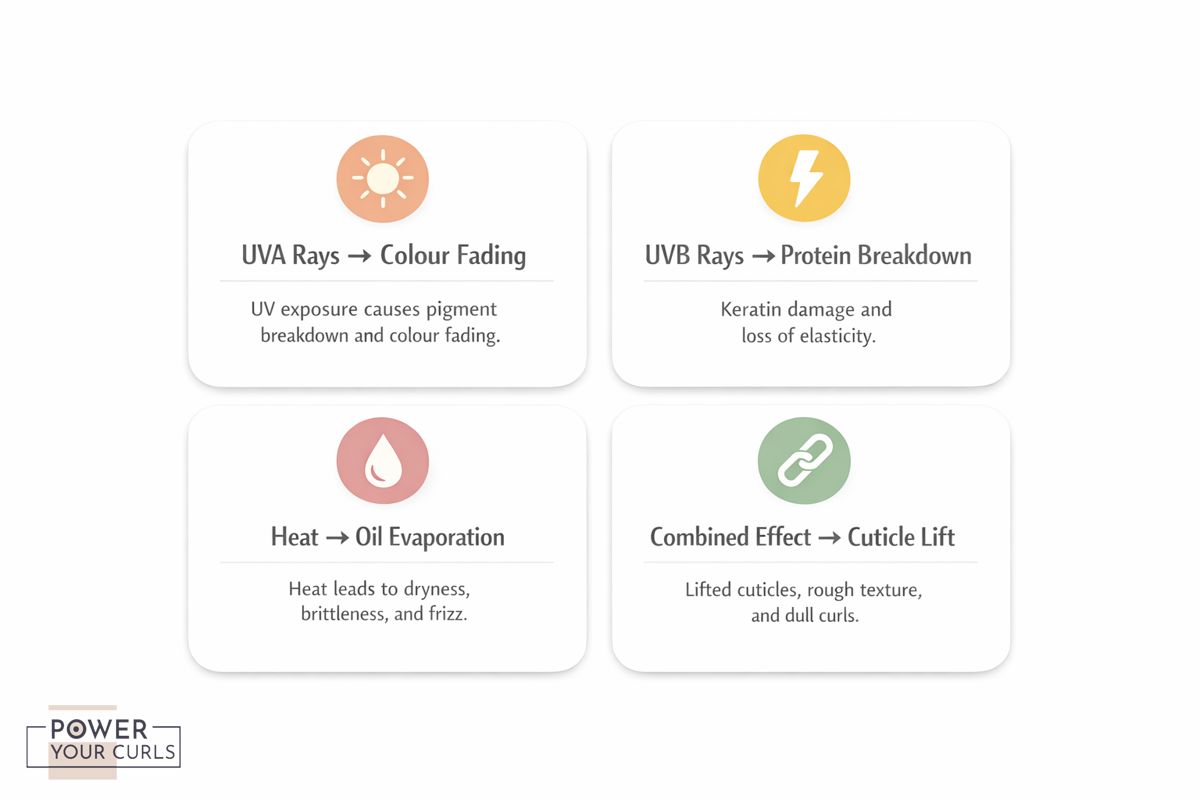
When you layer sun exposure on top of that baseline dryness, the result is compounded damage. As the American Academy of Dermatology confirms, UV radiation directly degrades the protein structure of the hair shaft weakening it. It can strip the moisture, and accelerate colour fading. For curly hair, which starts with less moisture to lose, this degradation hits harder and faster.
☀️ Science Note
Dermatologist Dr. Wilma Bergfeld of the Cleveland Clinic has noted that the sun’s rays can affect hair much like bleach does. Like bleach, it damages the outer cuticle layer, compromising the internal protein structure. For curly hair, this starts from a position of greater fragility.
What UVA and UVB Rays Actually Do to Your Curls
The sun emits two primary types of radiation that damage hair differently. Understanding the distinction helps you choose the right protection strategies.

Why Curly Hair Suffers More Than Straight Hair
It’s not just about sun exposure in general. Instead, it’s about the specific structural vulnerabilities of curly and coily hair types. These make them respond more severely to UV damage. A few key factors compound the problem significantly.
1. Higher Porosity = More Absorption
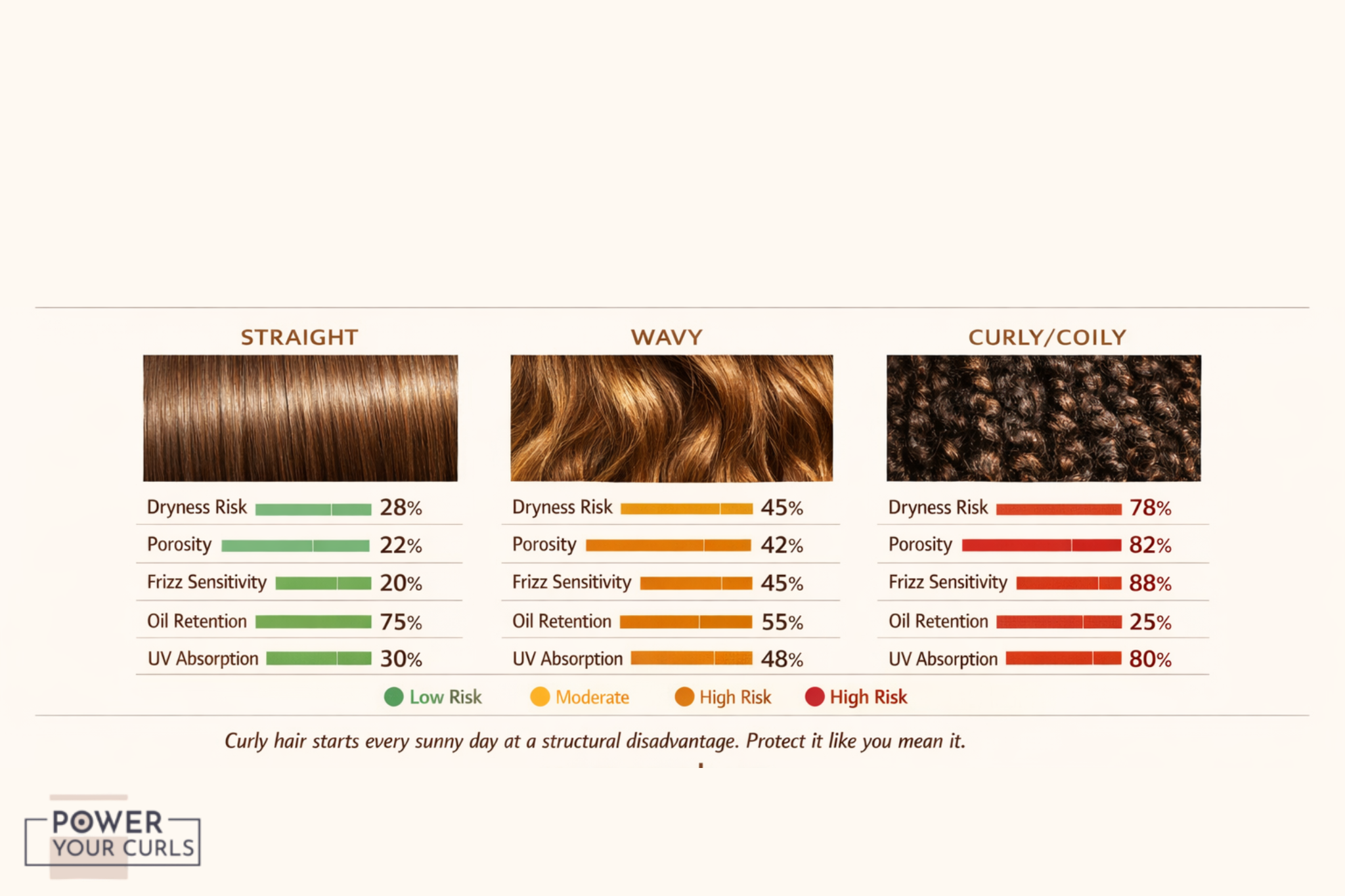
Curly and coily textures are naturally more porous than straight hair. This means the hair shaft absorbs more of everything, including UV radiation and the heat that drives away moisture. Higher porosity speeds up the rate at which damage accumulates.
2. Elevated Frizz Sensitivity
When the cuticle of a curly strand lifts when under UV stress, moisture from the air rushes in unevenly. This is the famous cause of humid-day frizz that curly hair wearers dread. Damaged, lifted cuticles are far more susceptible to this humidity-driven swelling than intact ones. Sun exposure essentially pre-damages the cuticle, making every humid day that follows worse.
3. Sun Damage Prevents Curls from Holding Shape
One of the less-discussed consequences of sun damage on curly hair is the structural protein degradation. This type of damage makes it harder for strands to hold their curl pattern.
The spring and bounce of a curl depend on intact keratin bonds. Once those are compromised by UVB radiation, the curl loses definition. No styling product can fully restore what the sun has broken down at a molecular level.
Understanding the UV Index for Curl Safety
The UV index is your daily guide to how much risk your hair and skin are facing. Here’s how to read the index in terms of your curl protection needs:

⚠️Common Misconception
Many people assume cloudy days are safe; they’re not. UV rays diffuse through clouds and reflect off of water, sand, and even pavement. Your curls experience UV exposure even on overcast days on the beach or just your normal every day commute. Daily accumulation of sun rays does add up faster than you think for your hair.
Why Curly Hair Is More Vulnerable: Factor Comparison
Myths About Sun & Curly Hair Busted
✕ Myth – Only colour-treated hair needs UV protection
UV rays affect all hair types and textures. Curly and coily textures, which are naturally more porous, are actually among the most vulnerable, regardless of whether they’re dyed.
✕ Myth – The sun just makes your hair lighter so it’s harmless
Lightening hair is a sign of protein and pigment destruction, not a cosmetic quirk. It indicates that the molecular bonds inside your hair have been chemically altered, just like bleach does.
✕ Myth – Regular conditioner is enough to repair sun damage
Regular conditioner moisturises the surface but cannot rebuild broken disulfide bonds or restore degraded keratin. The UV-damaged protein structure needs targeted prevention and repair treatments.
✓ True – Protective styles genuinely reduce UV exposure
Keeping your curls in a protective style minimizes exposure by reducing the total sun-exposed surface area. Styles like braids, buns, and twists tuck away the more-vulnerable parts of your hair while effectively sealing in moisture.
A Practical Sun Protection Routine for Curly Hair
The good news: sun damage to curly hair is largely preventable. It requires building a few intentional habits into your conditioning routine and your pre-outdoor ritual. Here’s what the research actually supports:
✓ Apply UV-protective hair care products before going out
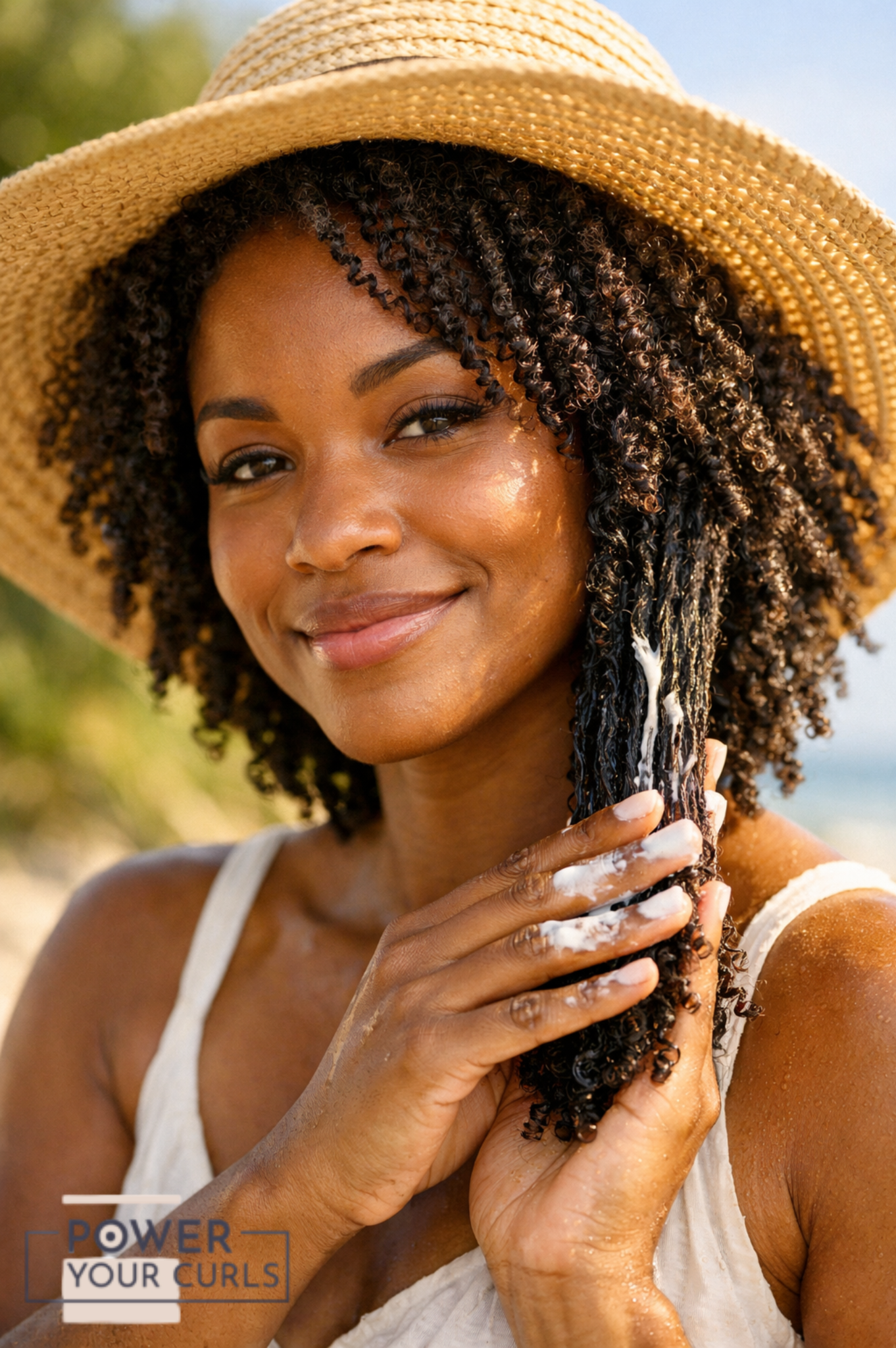
A good leave-in conditioner or other styling products with UV filters is like sunscreen for your tresses. They create a barrier between your locks and the radiation. Some natural UV-absorbers are aloe vera, argan oil, and shea butter. Also look for ingredients such as avobenzone, mangiferin (from mangoes), and naringin (from citrus fruits). They also have documented UV-blocking properties.
✓ Use protective styles on high-UV days
Twists, buns, and braids will protect your curls from the sun any day of the week. This is especially effective when combined with a UV-protective leave-in applied before styling.
Wear a wide-brimmed hat or silk/satin-lined scarf. Physical coverage is the single most effective UV protection method. Breathable materials keep your scalp cool while blocking radiation at the source. Silk or satin lining prevents friction that damages the curl pattern.
✓ Deep condition at least once a week during high-sun periods
Deep conditioners restore elasticity, replenish lost moisture, and help reinforce the hair’s natural barrier. If you’ve been in the sun, chlorine, or salt water, treat it as a non-negotiable, not a luxury.
✓ Avoid peak UV hours where possible
UV intensity is highest between 10am and 4pm. Scheduling outdoor time outside this window like morning walks and evening runs meaningfully reduces cumulative exposure over summer months.
✓ Reapply UV-protective products after swimming or sweating
Just as sunscreen wears off on skin, UV-protective hair products diminish with water exposure and perspiration. Build reapplication into your beach or outdoor routine. Try every 2–3 hours.
✓ Budget-conscious? Make your own leave-in spray
As covered in our budget-friendly curly hair tips, a DIY leave-in can do the trick. Water, a few drops of argan or coconut oil, and some aloe vera gel can work wonders. This combination provides lightweight protection and moisture against outdoor elements.

Your Complete Sun-Defence Product Arsenal
Sun damage hits curly hair at every stage before, during, and after exposure. These products from the our one-stop shop are organised by when and how to use them for maximum protection and recovery.
☀️ Step 1: Before You Go Out
Apply these before outdoor exposure to create a protective shield on each strand. Leave-ins and hair oils reduce UV absorption by coating the cuticle with a nourishing shield.
🌊 Step 2: While You’re Out
Reapply some more protection with these easy-to-use light oils and sprays. These are perfect to use as a top up even when you’re busy mid-day at the beach or pool. Bring these along whenever you’re doing any outdoorsy activities.
🌙 Step 3: Post-Sun Recovery
Your curls need a reset button after such a long day out in the sun. We recommend these deep conditioners, masques, and treatments to help your hair recover.
They target protein loss, restore elasticity, and rebuild the cuticle from the inside out.
🔄 Everyday Maintenance
Consistent daily and weekly routines are what prevent cumulative damage from building up over a summer season. These everyday essentials keep curls resilient and hydrated between deeper treatments.
What To Do After Sun Damage Has Already Occurred
If your curls have already taken a hit of frizz that won’t quit, it’s not the end of your curly hair journey. Even when the colour that’s faded, or the strands that feel dry and brittle, the damage isn’t necessarily permanent. But recovery requires consistency and the right approach.
The LOC method (Liquid, Oil, Cream) is particularly effective for post-sun recovery. This method layers moisture in a sequence that helps curly hair retain hydration longer. This way, it counteracts the drying effects of extended sun exposure. Weekly deep conditioning is non-negotiable during recovery periods.
As we outlined in our guide on essential leave-in conditioners for curly hair, the right leave-in isn’t just about moisture. It’s also about choosing formulas with protective and reparative ingredients that work between wash days to undo accumulated damage.
💡 Key Takeaways About Curly Hair and Sun Exposure
Curly hair’s is more vulnerable to UV radiation than other hair types because of its following traits:
- natural structure
- higher porosity
- less efficient oil distribution
- greater surface area exposure
Sun protection for your curls isn’t vanity. It’s about structural maintenance. Treat your UV protection routine with the same consistency you give your deep conditioning and y. Your curls will show the difference.
