

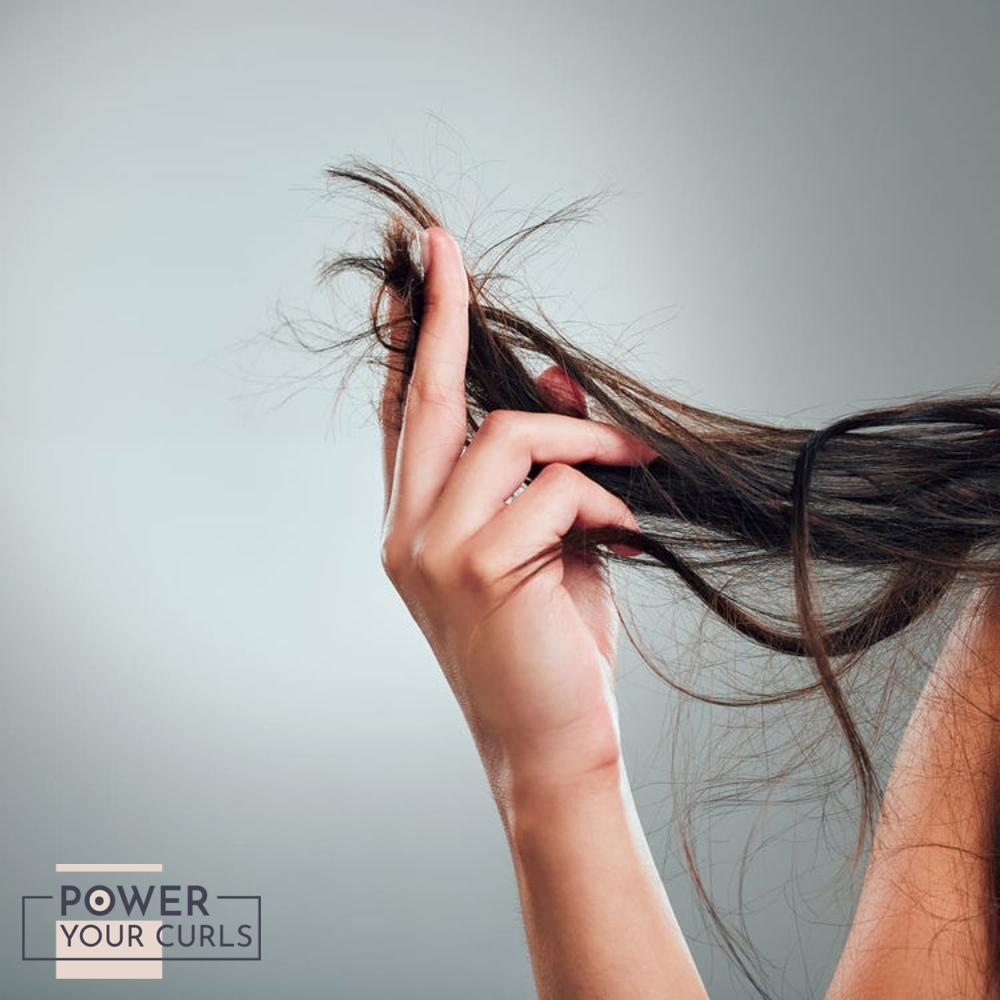
You can’t glue a split end back together, but you can stop new ones forming. For curly hair that means cutting down on friction and heat: detangle only when your hair is damp and full of conditioner, use a wide-tooth comb, blot instead of rubbing with a towel, keep heat low, and trim the splits you already have.
Curls split more easily than straight hair because of their shape, so these habits matter more for you than for most people. Here is why it happens, what to change, and when a trim is the only fix.
Why Does Curly Hair Get Split Ends?
A split end (the medical name is trichoptilosis) is what a worn-out hair fibre looks like at the tip. It shows up mostly on longer hair, because the ends are the oldest part of the strand and have had the longest exposure to sun, humidity, wind and styling (Monselise et al., 2017).
The split starts when the cuticle, the shingle-like outer layer, wears away. Once it is gone, the cement between the cells of the cortex gives a crack an easy path, and the split runs along the fibre (Gavazzoni Dias, 2015). That is why a split you leave alone can travel further up the strand.
Curly hair starts at a disadvantage. Its fibres are oval rather than round and twist along their length, and the tight bends make very curly hair more likely to break when it is handled and harder to comb without frizz (Gavazzoni Dias, 2015). Every rough detangle wears the cuticle a little more.
If your ends snap off rather than split, our tips to minimise curly hair breakage overlap with the ones below. If your curls have also lost their stretch and spring, our guide to hair elasticity shows you how to test it.
How to Prevent Split Ends in Curly Hair: 7 Habits
These are the changes that make the biggest difference, roughly in order of impact.
| Habit | Why it helps |
|---|---|
| Detangle in the shower, with conditioner in | Dermatologists advise combing curly hair only while it is damp, with a wide-tooth comb, and say the best time is before you rinse out your conditioner (AAD). |
| Use conditioner after every shampoo | Conditioner lowers friction between strands and makes combing easier (Gavazzoni Dias, 2015). The AAD recommends it after every wash, along the full length for curly hair. |
| Blot, don’t rub | Rubbing hair dry with a towel damages it; wrap it in a towel or T-shirt to soak up the water instead (AAD). |
| Keep heat low and occasional | Air-dry when you can, use the lowest heat setting, and use hot tools less often, ideally once a week or less (AAD). |
| Seal your ends with a light oil | In lab tests, hair treated with oils formed fewer split ends, with Brazil nut and mineral oil doing best (Gavazzoni Dias, 2015). |
| Wear loose styles | Pulling hair back tightly is a damaging habit; wear it loosely and use covered elastics (AAD). |
| Trim the splits you have | A split that is already there can’t be sealed shut for good, and left alone it keeps running. |
For the oil step, a few drops on the last few centimetres of your hair is enough. If you prefer a ready-made product, we stock the Ancient Egyptian Anti-Breakage & Repair Antidote Split-End Treatment Serum. Go easy on heavy butters: in the same tests, butters made hair harder to comb, not easier (Gavazzoni Dias, 2015).
Friction doesn’t stop at night. A satin or silk pillowcase or bonnet is the usual fix; see whether silk or satin is better for curly hair for what the evidence does and doesn’t show. If you’re not sure how much conditioning your curls need, here is how often to condition curly hair.
If heat has already done the damage, start with how to fix heat damaged curly hair.
Can You Repair Split Ends?
Not permanently. Conditioners, oils and silicones coat the cuticle, cut friction and help prevent further breakage (Gavazzoni Dias, 2015), so your ends look and feel smoother for a while. But a split end is a physical crack in the fibre, and cutting it off is the only way to get rid of it.
Bond-building treatments are also sold for damaged ends. We looked at the evidence for the best-known one in is K18 good for curly hair.
How Often Should You Trim Curly Hair for Split Ends?
There’s no fixed rule. A small trim every few months is a sensible starting point for most curls. Go sooner if you can see splits or white dots on your ends, if the ends keep tangling into knots, or if the last few centimetres won’t clump with the rest of the curl. If you want to keep your length, ask for a dusting, which takes off only the damaged tips.
If you trim at home, use proper hairdressing scissors for curly hair, not kitchen or craft scissors, and cut one curl at a time while your hair is dry so you can see where each curl ends.
Split Ends in Curly Hair: FAQ
Is curly hair more prone to split ends?
Yes. Curly fibres are oval and twisted, so they are more likely to break when combed or styled than straight hair (Gavazzoni Dias, 2015). Gentle handling matters more for curls.
Does heat cause split ends?
It can. Excessive heat can damage any hair type, so dermatologists advise air-drying when you can, using the lowest heat setting, and limiting hot tools to about once a week (AAD).
Can you get rid of split ends without cutting?
No. Serums and conditioners can make split ends less visible and help stop them getting worse, but only a trim removes them.
Do split ends make curly hair frizzy?
Often, yes. Weathered, damaged hair tangles and frizzes more (Gavazzoni Dias, 2015), so split ends tend to show up as frizzy, thin ends that won’t hold a curl.
