

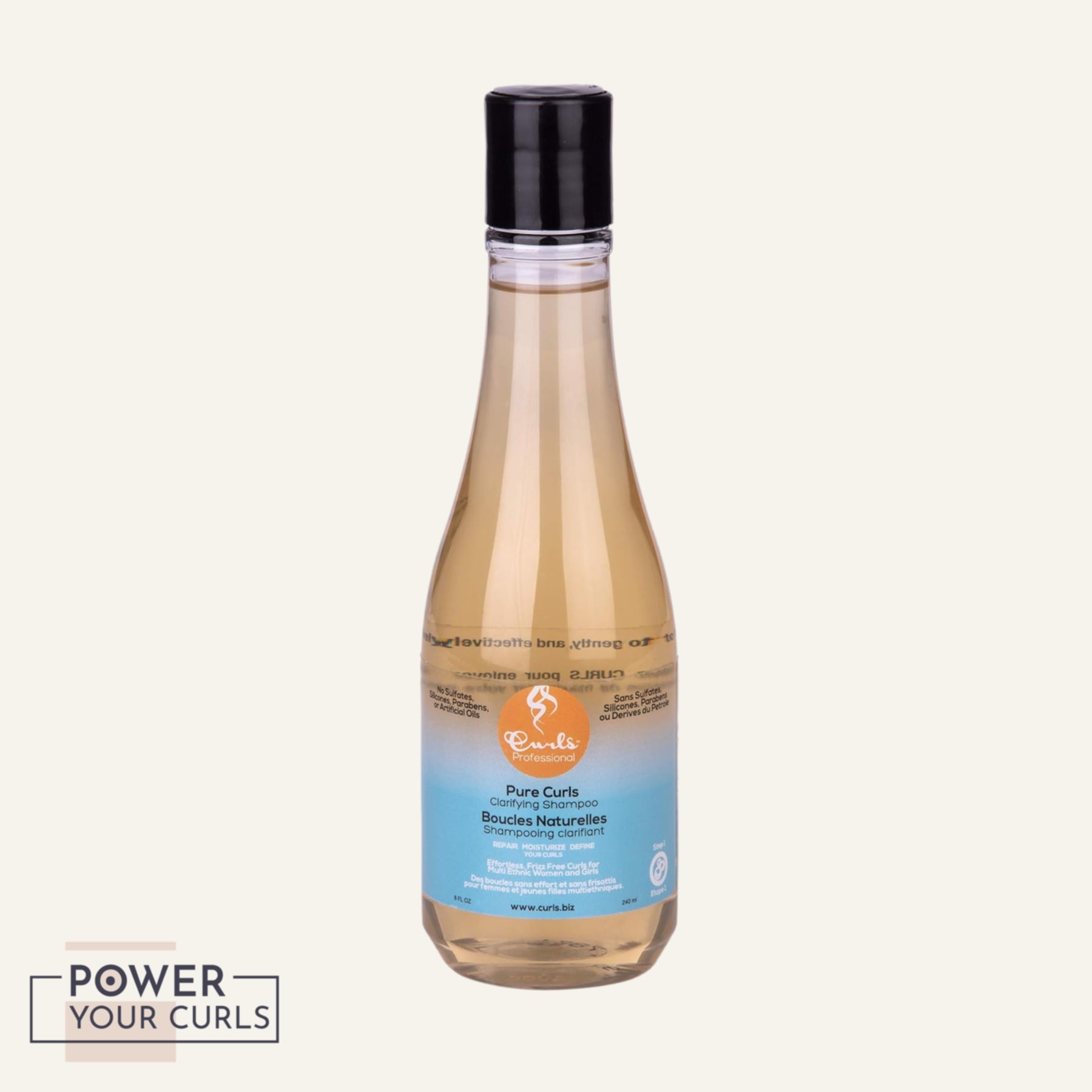
For most curly hair, use a clarifying shampoo about once every 10 washes, which works out to roughly once a month if you wash twice a week. Clarify more often, every one to two weeks, if you use heavy gels or butters, swim in chlorinated pools or see mineral build-up; a light, water-based routine can stretch to every two months.
The right number for you depends on four things: your water, how much product you layer, how many oils and butters you use, and how often you swim.
What Does Clarifying Shampoo Do?
A clarifying shampoo deep-cleans residue that your everyday gentle shampoo or co-wash leaves behind, such as styler polymers, oils, butters and conditioning agents. Curly routines collect more of this than most, because leave-in conditioners, creams, mousses and gels are all designed to stay on the hair.
A review of hair cosmetics notes that conditioning ingredients can be “so substantive to the hair that they can be difficult to remove”, and that some styling polymers build up and bind to shampoo surfactants (Gavazzoni Dias, 2015). The same review flags residue as a particular concern for people who use leave-on products often, especially on longer hair. Our guide to removing product build-up from your scalp covers the scalp side in more detail.
How Often to Use Clarifying Shampoo on Curly Hair
Start at about once every 10 washes and adjust up or down depending on your routine. That baseline comes from the same review, which suggests an anti-residue shampoo every 10 shampoos “or even more frequently, depending on the need” (Gavazzoni Dias, 2015).
| Your routine | How often to clarify | Why |
|---|---|---|
| Light, water-based stylers; wash once or twice a week | Every 6 to 8 weeks | Little residue to remove |
| Leave-in plus cream plus gel or mousse every wash day | About every 10 washes (around monthly) | Layered leave-on products add up |
| Heavy butters, oils or strong-hold gels | Every 2 to 3 weeks | Rich and film-forming products cling to hair |
| Swimming in a chlorinated pool most weeks | Every 1 to 2 weeks, plus a freshwater rinse after every swim | Pool water leaves chlorine and minerals behind |
| Hard-water signs (dull, rough, crunchy hair) | A chelating wash every 2 to 4 weeks | Minerals need a chelating formula |
| Bleached or heavily highlighted hair | Less often, and only when you see build-up | Highlighted hair is the most sensitive to anti-residue formulas |
Product labels vary, which is why the range is wide. The Pure Curls Clarifying Shampoo label suggests once every two months, while Aunt Jackie’s Power Wash Intense Moisture Clarifying Shampoo, a moisturising clarifier, is labelled for weekly or biweekly use. Follow the directions on the bottle you buy, and treat the table above as a starting point.
Hard water and UAE tap water
Most UAE tap water comes from desalination plants, and in some areas it is blended with groundwater (The National). Mineral levels can differ between emirates and buildings, so go by what your hair tells you rather than the postcode. White scale on taps and showerheads, hair that feels rough or squeaky after washing, and stylers that stop absorbing are all worth noting.
The evidence on hard water and hair is mixed. In one lab study, hair treated with hard water over three months had lower tensile strength than untreated hair, although the authors note an earlier study found no significant effect (Luqman et al., 2018). The same paper explains that chelants work by surrounding metal ions so they can be removed. Read more in our guide to hard water and your hair.
Product load, oils and butters
The more leave-on layers you use, the sooner you will need to clarify. If you follow the leave-in, cream and gel method, or stack a mousse over a cream, plan on clarifying around monthly. Butters, heavy oils and strong-hold gels tend to shorten that gap.
Swimming
Swimmers usually need to clarify more often. A Cleveland Clinic dermatologist says hair may become “dry, rough, dull and more susceptible to breakage” with repeated chlorine exposure, and recommends wetting hair with clean water before you swim, rinsing straight after, and using a clarifying shampoo occasionally but not every day (Cleveland Clinic). If your hair turns green, see these tips to fix green hair after swimming.
Signs You Need to Clarify Curly Hair
On curls, build-up usually shows up as poor definition rather than flakes. Look out for:
- Curls that will not clump or hold their shape, even with your usual products
- Products that sit on top of your hair instead of sinking in
- A coated, waxy or tacky feel once your hair is dry
- Dullness, even straight after a wash
- Wash-day results that keep getting worse although your routine has not changed
Limp, over-stretchy curls can also be a moisture or protein problem rather than build-up, so check our guide to hygral fatigue and protein overload before you reach for a stronger shampoo.
How to Clarify Curly Hair Without Drying It Out
Clarify the scalp, let the lather clean the lengths, and condition straight away. That last step matters most: the review cited above says residue can be removed “without stripping the fiber” when the anti-residue shampoo is followed by a thick moisturising mask, preferably with hydrolysed amino acids, silicones and vegetable oils (Gavazzoni Dias, 2015).
- Wet your hair thoroughly. Saturated hair spreads shampoo more evenly, so you need less.
- Massage the shampoo into your scalp with your fingertips. Let the lather run down your lengths rather than scrubbing them; the Power Wash label specifically says not to shampoo vigorously.
- Rinse well, and repeat if you use a strong-hold gel. A second wash lifts what the first one loosened.
- Follow straight away with a deep conditioner or mask. Leave it on for the time on the pack. The American Academy of Dermatology also advises using conditioner every time you wash textured hair (AAD).
- Style with less product for the next few washes. Start with a smaller amount of your curl cream and add more only if your curls need it.
If your hair feels dry easily, choose a clarifier made to cleanse and moisturise in one step. You can compare clarifying formulas in our shampoo collection. The Iva Curls Clarifying Shampoo lists aloe vera to remove product build-up alongside amla and hibiscus, and Twisted Sista’s Luxurious Clarifying Shampoo is a sulfate-free formula with coconut, avocado and almond oils, according to its label.
Clarifying vs Chelating vs Everyday Shampoo
Everyday shampoo handles routine cleansing, clarifying shampoo removes product residue, and chelating shampoo targets minerals. Some products do two of these jobs, so read the label.
| Everyday (gentle) shampoo | Clarifying shampoo | Chelating shampoo | |
|---|---|---|---|
| Main job | Cleans scalp oil and sweat | Removes styler, oil and conditioner residue | Binds and removes minerals and metal ions |
| How often | Every wash day | About every 10 washes, more if needed | Every 2 to 4 weeks if you have mineral build-up |
| Best for | All curl types | Heavy product users, swimmers, a fresh start before a new routine | Hard water, frequent swimmers |
| Follow with | Conditioner | Deep conditioner or mask | Deep conditioner or mask |
Clarifying Shampoo FAQs
What does clarifying shampoo do to curly hair?
It removes the build-up of leave-in products, oils and butters that gentle shampoos leave behind, so your curls can clump and absorb products again. Follow it with a deep conditioner so your hair does not feel stripped.
Can I use clarifying shampoo every week?
Only if your routine calls for it, for example if you swim most weeks or use heavy gels, or if your product is labelled for weekly use. For most curly routines, once every 10 washes is enough.
Is clarifying shampoo bad for curly hair?
No, not when you use it occasionally and condition afterwards. Problems come from clarifying too often or skipping the mask, which can leave curls dry and frizzy.
Should I clarify before trying a new curly hair routine?
Yes. Clarifying gives you a clean starting point, so you can see how new products actually perform. The Pure Curls label recommends it for exactly this reason.
